
Nigeria’s electoral politics is shaped not only by voter choice but also by deeply rooted informal power-balancing conventions shaped around region, religion, and ethnicity (tribes). These conventions, while not being constitutionally binding, have acquired near-sacred status in elite bargaining and voter psychology. On the basis of the convention around regional power rotation, presidential power should be zoned to the southern region following the 8-year (2015-2023) presidential stint of the late President Mohammadu Buhari, who is of the northern region.
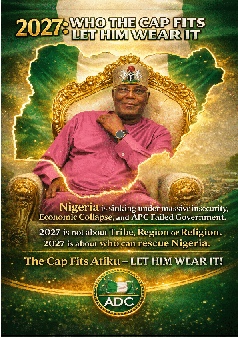
However, pertaining to the approaching 2027 general election, the adamant stance of Atiku Abubakar of the ADC to vie in the presidential ballot – on account of the widespread perceived underwhelming performance of the incumbent president – challenges the North-South power rotation convention, more so in the circumstance where President Bola Tinubu of the APC, a Yoruba southerner who is about to complete his elected four-year term, is also demanding reelection to another presidential term.
But the hard fact is that, weeks to the 2027 general election, the country is enmeshed in a myriad of serious socio-economic challenges that qualify to be described as a national crisis. It is a crisis that has created a situation in which the North-South power rotation convention is intersecting with:
- Severe nationwide insecurity
- Massive economic decline
- Intolerable cost of living crisis
- Rising ethno-religious suspicions and tensions
Though the World Bank’s October 2026 assessment of a 4.2% GDP growth hints at some semblance of economic progress, its estimation that 60% of the population is living below the national poverty line (as at 2025), of an average inflation rate of 15.7% (between March and July 2026), and of 20.3% food inflation (as at July 2026), is a clear admission of the continuing hardship felt around the country.
The World Bank’s assessment indicates that serious poverty and household affordability problems persist despite improvements in some economic indicators, which proves that macroeconomic stabilization is not equivalent to improved living standards of people.
This makes the question of whether the economy is growing a simplistic one, as the more consequential question is whether the incumbent APC government’s economic policy is improving the lives of ordinary Nigerians.
The widespread disillusionment with the performance of the incumbent government, especially in the northern parts of the country, where the chanting of the ‘Tinubu must go’ mantra is becoming a ritual practice, aptly answers this question.
This countrywide disillusionment has resulted in a crisis that pits glaring leadership failure against incumbent entitlement. This has given rise to the raging national argument on the justification of adhering to the informal power rotation convention in the prevailing circumstance of an exceptional situation – a serious national emergency induced by underwhelming leadership performance. It is an argument that pitches the measurable outcomes of leadership and governance against the exclusivity of political office and rhetoric.
But before delving any further into the substance of the debate, two subjects at its center must first be understood for what they represent. They are:
- Power rotation, which is a political convention rooted in elite bargains, federal character, national inclusion, and the desire to prevent permanent domination by one section of the country.
- National leadership, which is a constitutional responsibility, involving the security, economic welfare, territorial integrity, and institutional stability of the Nigerian state.
These two subjects are not inherently contradictory. The arguments arise when political conventions become so rigid that they are treated as more important than the country’s immediate governing requirements.
Without a doubt, in a plural society such as Nigeria, inclusion through power rotation is a vital necessity for enduring political stability. Yet, the more important question is whether power rotation considerations should operate as absolute electoral eligibility rules or as important considerations within a broader assessment of national leadership, especially in exceptional national emergency situations – exceptional moments.
To contextualize the exceptional moment argument, it would be useful to cite some historical precedents when political institutions, parties or national elites recognized that extraordinary circumstances required leadership arrangements beyond ordinary political calculations.
Let’s begin with international precedents before looking homeward.
- International Precedents
- United Kingdom, 1940: Winston Churchill replaces Neville Chamberlain
In May 1940, Britain faced an existential national emergency.
Nazi Germany had invaded Western Europe. Allied military positions were deteriorating, and the British government faced serious questions about its wartime strategy.
Prime Minister Neville Chamberlain was increasingly criticized for his leadership and the failure of his appeasement policy. Lacking visible public or parliamentary support, Chamberlain’s political authority was severely weakened. This forced him to resign on 10 May 1940, the day Germany launched its western offensive.
Winston Churchill was appointed as prime minister.
The point in this is that Churchill’s appointment was not simply a routine transfer of power. It was a recognition that the country needed a different kind of leadership under extraordinary circumstances.
Churchill subsequently formed a broad coalition government involving the Conservative, Labour, and Liberal parties.
This case is important in that it shows that:
- National survival is way more important than preserving the incumbent’s political position.
- Parliamentary or citizens’ confidence and the capacity to lead are decisive in leadership selection.
- A broad coalition was assembled to confront the national emergency.
- The government prioritized the immediate survival of the country over ordinary partisan competition.
The lesson here is that an existential crisis can fundamentally alter the criteria by which political leadership is evaluated. The comparison is not that Nigeria’s current circumstances are identical to Britain’s wartime situation. Rather, it illustrates the principle that extraordinary national threats can require a reassessment of normal political expectations.
2. United States, 1861: Abraham Lincoln and the American Civil War
Lincoln assumed office in March 1861, when the United States was on the brink of civil war. Southern states had begun seceding, national unity was threatened, and the constitutional order was facing its gravest crisis.
Lincoln’s particularly important leadership decision was his appointment of political rivals to his cabinet. His Cabinet included prominent men who had competed against him for the Republican presidential nomination:
- William H. Seward.
- Salmon P. Chase.
- Edward Bates.
Lincoln recognized that national leadership required the mobilization of talent, experience, and competing political perspectives rather than the selection of individuals simply because they belonged to his immediate political circle.
This arrangement became known as the Team of Rivals. It contrasts sharply with the historic ethnocentric proclivities of Nigeria’s APC governments.
It provides an example of leadership being understood as the capacity to assemble and deploy the best available national talent.
It also offers a useful corrective to personality-centered politics: that national emergencies require strong institutions and competent teams, not merely a supposedly exceptional individual, a messiah figure.
3. India, 1991: P.V. Narasimha Rao and the economic emergency
Following a prolonged economic crisis and the assassination of Prime Minister Rajiv Gandhi in 1991, India was thrown into a severe socio-economic crisis, being confronted with:
- A severe balance-of-payments crisis.
- Critically low foreign-exchange reserves.
- Political instability following the assassination of former Prime Minister Rajiv Gandhi.
- A fragmented parliament.
- Serious uncertainty about the country’s economic future.
Unlike the traditional convention, P.V. Narasimha Rao emerged as Prime Minister despite his Congress Party having secured only a minority in parliament. He subsequently appointed economist Manmohan Singh as Finance Minister.
The government introduced far-reaching economic reforms, including industrial deregulation, trade liberalization, and changes to foreign investment policy. The reforms fundamentally transformed India’s economic trajectory.
The leadership decision of 1991 in India is relevant because it demonstrates the importance of competence in selecting and organizing national leadership. The significant point is that the Rao administration responded to the emergency by assembling a governance authority imbued with political, technical, and economic competence.
Rao’s appointment of Manmohan Singh is particularly relevant: the economic crisis required the deployment of expertise and prioritizing economic capacity rather than the assumption that ethnic or partisan affiliation, or political seniority alone, was sufficient.
4. South Africa, 1994: Nelson Mandela and the Government of National Unity
South Africa’s 1994 transition is one of the most relevant examples for a deeply divided, multi-ethnic society – such as Nigeria.
Following apartheid, South Africa faced enormous challenges:
- Deep racial divisions.
- Political violence.
- Institutional distrust.
- Severe socioeconomic inequalities.
- The need to build legitimacy across previously hostile communities.
Nelson Mandela became the country’s first democratically elected Black president.
However, his administration did not treat electoral victory as permission to exclude political opponents – as is the practice in contemporary Nigeria.
A Government of National Unity was established, incorporating the National Party and Inkatha Freedom Party alongside the African National Congress. F.W. de Klerk, the erstwhile President under apartheid rule, became Deputy President.
The administration sought to build a new political order through inclusion, reconciliation and institutional reconstruction.
The central lesson taught by this South African example is that in deeply divided societies, leadership competence must include the ability to build trust across historical divisions.
This case is particularly useful for considering the relationship between national emergency and inclusion. It does not establish that representation should be discarded. It demonstrates that political inclusion can be pursued through a broad governing arrangement rather than being made entirely dependent on the identity (religion, tribe, or region) of the president.
5. Bosnia and Herzegovina: When ethnic safeguards become governance obstacles
Following the 1992–1995 war, the Dayton Peace Agreement established a complicated political structure designed to protect the country’s three constituent tribal people or ethnicities: Bosniaks, Serbs and Croats.
The system incorporates ethnic representation, power-sharing arrangements, and veto mechanisms. Though these safeguards were intended to prevent domination by one community, in practice, the arrangements also created substantial obstacles to effective governance.
This is reported in the 2026 Bertelsmann Transformation Index country report documents, which show:
- Ethnic vetoes obstructing collective decision-making.
- Delays in government formation.
- Fragmented authority.
- Ineffective policymaking.
- Institutional paralysis when competing ethnic elites refuse compromise.
The lesson the Bosnia and Herzegovina experience teaches is that representation safeguards can protect minorities, but when their application becomes excessively rigid, they can also weaken the state’s ability to govern.
One particularly striking example was the period after the October 2018 elections, when the Council of Ministers took 14 months to form. Another is when a caretaker government remained in office throughout the subsequent four-year mandate.
6. Lebanon: The danger of rigid sectarian power-sharing
Religiously divided Lebanon is a classic example of how a political system organized around identity representation can become vulnerable to institutional paralysis.
The constitutional convention in the country is that major political offices are shared and distributed along religious lines:
- President: Maronite Christian.
- Prime Minister: Sunni Muslim.
- Speaker of Parliament: Shia Muslim.
The system was intended to maintain political equilibrium among religious communities.
However, Lebanon experienced prolonged institutional deadlock following the expiration of President Michel Aoun’s term in October 2022. Due to the unbridgeable religious divisions, parliament repeatedly failed to elect a successor. This deadlock caused the country to operate without a president until January 2025 – three years.
During this period of presidential vacuum, Lebanon was also experiencing a severe economic crisis, deteriorating public services, and serious security challenges – as the caretaker government faced institutional difficulties which paralyzed the state and undermined its ability to address urgent socioeconomic, financial, security, and humanitarian challenges
While the situation in Nigeria has not gotten near the Lebanon scenario, the lesson Lebanon teaches is that a political arrangement designed to protect communal or identity (Tribe, Region, Religion) interests can become dysfunctional when elite competition and sectarian bargaining prevent the timely exercise of governmental authority.
B. Nigerian precedents
1. The 2010 Doctrine of Necessity
In November 2009, President Umaru Musa Yar’Adua travelled to Saudi Arabia for medical treatment. His prolonged absence created a constitutional vacuum. Although Jonathan was Vice-President, he had not formally assumed presidential powers because Yar’Adua had not transmitted the constitutionally required declaration to the National Assembly.
Nigeria faced a serious institutional crisis:
- The President was unable to discharge his constitutional responsibilities.
- The Vice-President’s authority was disputed.
- The country faced uncertainty over executive decision-making.
- Political actors were divided over the constitutional implications.
On 9 February 2010, the National Assembly invoked the Doctrine of Necessity and empowered Jonathan to serve as Acting President.
This precedent of an exceptional moment matters because the National Assembly ultimately prioritized the continuity of government over a rigid interpretation of procedural expectations. The central lesson being that constitutional governance must remain capable of responding to exceptional national circumstances.
While this is not a direct example of ethnicity or zoning being abandoned, it is a clear example of national necessity taking precedence over political and procedural paralysis.
The precedent is especially valuable because it demonstrates that Nigeria itself has previously accepted the principle that extraordinary circumstances can justify exceptional political decisions.
2. Nigeria’s 2015 election: Peaceful transfer over partisan survival
The 2015 presidential election was one of the most consequential democratic moments in Nigeria’s Fourth Republic.
Nigeria was experiencing:
- The Boko Haram insurgency.
- Significant insecurity in the Northeast.
- Economic uncertainty associated with falling oil prices.
- Political polarization.
- Fears of widespread post-election violence.
The incumbent, Goodluck Jonathan of the PDP, lost to Muhammadu Buhari, the opposition APC candidate.
Jonathan conceded defeat before the final completion of the electoral process and subsequently facilitated a peaceful transfer of power.
This was historically significant because it represented the first time an incumbent Nigerian president had peacefully lost an election and transferred power to an opposition party since the restoration of civilian rule in 1999.
The case is particularly instructive because the national interest in democratic continuity was more important than the incumbent’s political survival.
It also demonstrates that Nigeria’s political system can accommodate a major departure from an existing political arrangement without the collapse of the federation.
While this was not a case of abandoning regional zoning, it was a case of democratic legitimacy and institutional stability prevailing over partisan interest.
4. The 1975 change of leadership: Murtala Mohammed and the Gowon administration
In July 1975, General Yakubu Gowon was removed from office while attending an OAU summit in Kampala. Brigadier Murtala Mohammed assumed leadership.
The change came after mounting concerns about military administration, corruption, the delayed transition to civilian government and dissatisfaction with the Gowon administration.
Murtala’s administration initiated a series of reforms, including:
- A renewed commitment to civilian government.
- A restructuring of the federal system.
- A reorganization of the public service.
- An anti-corruption campaign.
- A program of political and administrative reforms.
Murtala’s tenure was short, ending with his assassination in February 1976, but his administration profoundly influenced the subsequent transition under Olusegun Obasanjo.
Although the change was achieved through a military coup and not a democratic election, it still illustrates how perceived state failure can produce demands for a fundamental change in leadership and governing priorities. While the examples cited might not exactly mirror the power rotation convention driving the present debate in the country, the point is that in all cases, they represent historical moments when national leadership considerations transcended identity or rotation.
The countries cited were faced with an exceptional social, political, or economic circumstance that merited their taking exceptional leadership decisions that were rather out of the norm. While not claiming to be the equivalent of Nigeria’s zoning arrangement, in each case, the political system selects or reorganizes leadership primarily because of exceptional national circumstances such as the need for competence. Institutional legitimacy or national survival. This was mainly in recognition that:
- National emergencies can require leadership beyond ordinary political conventions or loyalties,
- Leadership appointments should prioritize identifying the appropriate person for exceptional national responsibility
- Competence and inclusion or zoning should be complementary, not competing objectives
Likewise, on the threshold of the 2027 general election, Nigeria is confronted with a debilitating security situation, alongside a massive collapse of the national economy that has precipitated an unprecedented cost of living crisis – directly connected to the incumbent government’s economic policy choices. The situation has literally dovetailed into a national emergency. This makes the 2027 election an exceptional moment which deserves an exceptional decision by the Nigerian electorate.
It is a moment that calls for carefully considering whether to rigidly stick with the (informal) North-South power rotation/zoning convention, or to search for the one with the leadership competence to rescue the country from the prevailing serious socio-economic malaise.
If the cap fits Atiku, let him wear it.
Share the story!
You can create wealth, live healthier, look better, and become more knowledgeable. You deserve this life! Do not hesitate to earn it. Visit our marketplace today.