
The president backs down and the presidency and national Assembly backtracks on the IMF dictated finance bill.
From the time he was elected President of Kenya in August 2022 , William Ruto has set himself on a coursed of deepening his country’s ties to the Anglo-Saxon world, especially Britain and the US. So much so, that he seemed bent on the total vassalage of Kenya to American and British overlordship. This is very much, a hypocritical turnaround, given that at very beginning of his presidency, he appeared to espouse Pan-Africanism, which earned him praises and admirations from across the continent. He railed against Africa’s humiliation by the West, and condemned the international financial architecture and other neocolonial tendencies that have contributed to Africa’s poverty, instability, and underdevelopment.
However, In due course, Ruto’s posturing turned out to be mere rhetoric, devoid of any commitment to the protection of the national sovereignty of Kenya. Within two years of his presidency, Ruto, has decidedly turned Kenya into a neocolonial outpost and proxy state of the West, specifically the US. He has renewed the controversial agreement that leased Kenyan territories to Britain for use as military bases, and recently, (April 2024) he expanded it to include the basing of US troops in the country.
Though the latest agreement (with the US government) paints Kenya in the colors of a US satellite state, desecrates its sovereignty, and put the lie on Ruto’s Pan-Africanist posturing, it earned for the country the designation as a Major Non Nato Ally (MNNA) in Africa, a designation that symbolizes the cementing of Kenya firmly into the sphere of the US led global “rules based order”. To demonstrate his total acquiescence, he agreed to the US order to deploy Kenyan police officers to crime riddled Haiti, to combat runaway gangsterism – a problem that is directly caused by decades long US non-stop interferences in the affairs of that failed country. One would think that, for a president of a developing country that is beset by poverty, high youth unemployment and rampant corruption; a situation that has culminated in wide spread hunger, poor healthcare, a dysfunctional education sector, and abysmal public infrastructure, ensnaring the country on some grandiose military adventures abroad would be totally ruled out of the question.
But, submission to the military fist of the “rules base order” is not always deemed sufficient. “Full spectrum dominance” has to include subjugation to the dictates of the soft power instruments of neo-colonial control; the World Bank and IMF. These have sank their fangs on Ruto’s government, demanding the implementation of their trade mark neo-liberal economic policies, such as government disinvestment and privatization of education, agriculture, and healthcare, and the introduction of a punitive taxation regime – the same neoliberal policies that have, over the years, strangulated the economies of many African countries and deepened their underdevelopment and poverty.
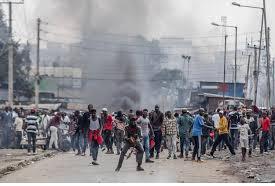
Not surprising, from the start of his presidency in August 2022, the IMF advised tax policies of President Ruto’s government has led to sharp increases in the income tax and healthcare bills of Kenyans , and VAT on gasoline has doubled within the period, increasing to 16% . This has resulted in widespread hardships and repeated protests around the country, from since he won the 2022 elections. Kenyans complain that his government has grossly failed to fulfill its campaign promises and has failed to address the country’s high cost of living and rampant joblessness. Last July, several people were killed and dozens were arrested when protest against a portfolio of tax hikes, led by Raila Odinga, leader of the opposition Azimio Coalition, turned violent around the country.
In May, 2024, the Kenyan central Bank disclosed that inflation stood at 5.1% year-on-,year, with food and fuel prices rising 6.2% and 7%, While, the World Bank forecasts that GDP growth would slow to 5% this year after reaching 5.6% in 2023 (4.9% in 2022). Meanwhile, the country’s international debt obligations of about $80bn are about 70% of GDP. Therefore, the International Monetary Fund (IMF) advised the government to make “sizable and upfront” fiscal adjustment to its 2024/25 budget. Based on this recommendation, the government sent yet another taxation bill (as part of the country’s 2024 appropriation bill), which the government considered necessary to reduce the country’s budget deficit, to the national parliament. The original draft of the bill stipulated increasing levies on basics necessities such as fuel, mobile money transfers, internet banking, sanitary pads and diapers.
Although the government justified the bill on the need to generate sufficient money to meet its ambitious infrastructures development plan, it is obvious that the main reason is its needs to find money to meet its obligations of repaying debts to IMF backed foreign creditors.
However, Kenyans citizens, already overtaxed, unanimously argued that the proposed new taxation regime, if passed, will further worsen the economy, increase unemployment and escalate the already unbearable high cost of living. To forestall its passage, protest, led by determined, and apparently well organized youths, broke out around the country.
Originally, the protests began as on-line activism of young tech-savvy Kenyan youths on social media platforms; Instagram, TikTok, Instagram and X (formally, twitter). But the government was undeterred. After all, when the master (IMF) give the orders, the voices of the people, the Kenyan electorate, becomes irrelevant and inconsequential, Or so they thought. Hence, they stubbornly pressed on, got the parliament to pass the bill through its first reading, and scheduled it to pass the second and final reading on Tuesday, June 18,2024.
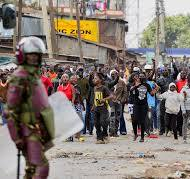
That was when the millions of impoverished youths quickly catch-on and leaped aboard the virtual, internet protest, turning it into a real-world street protest, which, beginning in Nairobi, the Kenyan capital city, quickly spread across the whole country.
On Tuesday June 18, the scheduled day of the second reading of the bill, hundreds of youths gathered near the Kenyan parliament building in a protest against the bill, dubbed “Occupy Parliament,”. Despite this, the pliant, “rubber stamp” National Assembly sat, passed the bill, and prepared to sent it to the president for his accent.
The news of the passage of the bill enraged the protesting youths ringed around the parliament building. Boiled over in anger, they overran the police cordons and barricades, and stormed the building, manhandling any “ honorable” unfortunate enough to be caught, and set parts of the building ablaze. Around the country, the homes of several MPs were stormed and their properties destroyed. The office of the governor of Nairobi, located close to the parliament building was also fire-bombed and set ablaze. In Kikuyu town, near the capital Nairobi, protesters set fire to the National Government Constituencies Development Fund office
Ever Since the passage of the controversial bill on Tuesday, June 18, the country has been engulfed in waves of protests. Led by thousands of youths, the protesters are adamant and resolute, against the anti-people bill. Over the week, notable protest were observed to have taken place in 35 of Kenya’s 47 counties, including in president William Ruto’s home county of Uasin Gishu, his main support base.
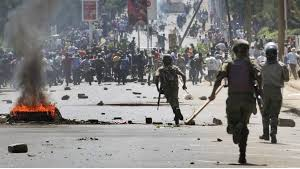
Later on, on Tuesday evening, following the violent public protestations, the parliamentary committee on finance began back-tracking, and recommended that the government withdraw some of new taxes proposed in the bill, saying in an official statement that. “The Finance Bill has been amended to remove the proposed 16% VAT on bread, transportation of sugar, financial services, foreign exchange transactions, as well as the 2.5% Motor Vehicle Tax,” . Taking cue, on Wednesday , at a press briefing, President William Ruto announced that he will not sign-on the budget bill. Speaking on the matter, he said:
“The people have spoken . I concede, and therefore I will not sign the 2024 finance bill, and it shall subsequently be withdrawn.”However, he cautioned that if the finance bill is withdrawn, there would be a substantial deficit in funds for development initiatives . President Ruto also said he is ready to discuss amendments to the bill with representatives of the country’s youth. And promised that, going forward, “there will be no extrajudicial killings.” In a follow up address on Sunday, he reaffirmed his government readiness to engage in dialogue with the protesters and announced that there are initiatives to address youth unemployment and enhance accessibility to higher education in the budget bill.
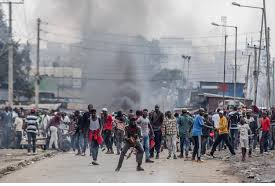
Despite their apparent victory, the nationwide protest led by young Kenyans has come at a steep price in blood, limbs and lives around the country.
During his address the president informed that about 214 Kenyans were involved in the “skirmishes” with the police. And that some 14 of them are still in hospitals, including one in the ICU unit. He added that a total of six young people lost their lives during the Tuesday’s upheaval, expressing condolences to the families of those killed and injured.
Nevertheless, despite the president suspending accent, parliament walking back on aspects of the bill, and the presidency announcing that “fees for mobile money transfers will not increase, and the excise duty on cooking oil has also been eliminated, and, housing fund and proposed social health insurance taxes would not be subject to income tax, and the proposed eco levy would only be levied on imported finished products that contribute to the generation of e-waste”, many Kenyans have remained unconvinced. In their eyes , President Ruto’s credibility is irreparably rend — and they are now demanding his resignation.
Hence, the protests have continued, with reports of two more fatalities and at least 200 more people suffering injuries in the unending protest.